
G·P·R·O: Rules of the Game
For 2 to 6 players · Ages 55+ · 60 to 90 minutes. Collect all four letter tiles — G, P, R and O — and shout “G-PRO!” to win.
Objective
Each player tries to collect all four letter tiles: G, P, R and O. The first player to hold all four shouts “G-PRO!” and wins.
| Letter | Stands for | Earned by |
|---|---|---|
| G | Green Literacy | Knowledge cards: Water, Energy, Nature, Recycling |
| P | Prompt Intelligence | AI Prompt cards: all three steps completed |
| R | Real-World Reasoning | Shopping cards |
| O | Own It | Any card: the player makes a specific, named commitment and the group votes YES |
Reading card rewards
| Symbol | Meaning |
|---|---|
| •G• / •P• / •R• | Earn that letter tile if the group judges the answer genuine (for P: all three AI steps completed) |
| •+1• / •+2• / •+3• | Earn 1, 2 or 3 Community Points |
| •⚡• | Draw 1 Power Card instead of earning Community Points |
| •P+⚡• | Earn the P tile AND draw 1 Power Card |
| •R+1• | Earn the R tile AND 1 Community Point |
| •+N each• | Every player who takes part earns N Community Points |
| •+N shared• | The table earns N Community Points to share between the players, as described on the card |
The O tile has no printed symbol on any card. It can be earned on any card, at any time, when a player makes a specific commitment and the group votes YES. When a card shows •⚡• as its only reward, the player draws one Power Card instead of earning Community Points; a letter and •⚡• together earn both. Wild Cards are marked “Wild Card · whole table” instead of a symbol: follow the text on the card.
What is in the box
| Challenge Deck | 130 Challenge Cards across six themes, plus 20 Wild Cards shuffled in — 150 cards in total. |
| Power Deck | 32 Power Cards: 8 types with 4 copies each. Kept as a separate deck. |
| Letter tiles | 6 sets of G, P, R, O tiles (one per player colour), plus spare tiles for Double or Nothing. |
| Pawns & die | One pawn per player and a standard six-sided die. |
| Community Points | Tokens or a paper score sheet. |
Setup
- Place the board flat on the table.
- Shuffle the 130 Challenge Cards and 20 Wild Cards together. Place them face-down in the upper Card Deck Zone.
- Shuffle the 32 Power Cards and place them face-down in the lower Card Deck Zone.
- Every player puts their pawn on START HERE in the Community Hub, with 0 Community Points and no letter tiles.
- The youngest player goes first. Play proceeds clockwise.
The board
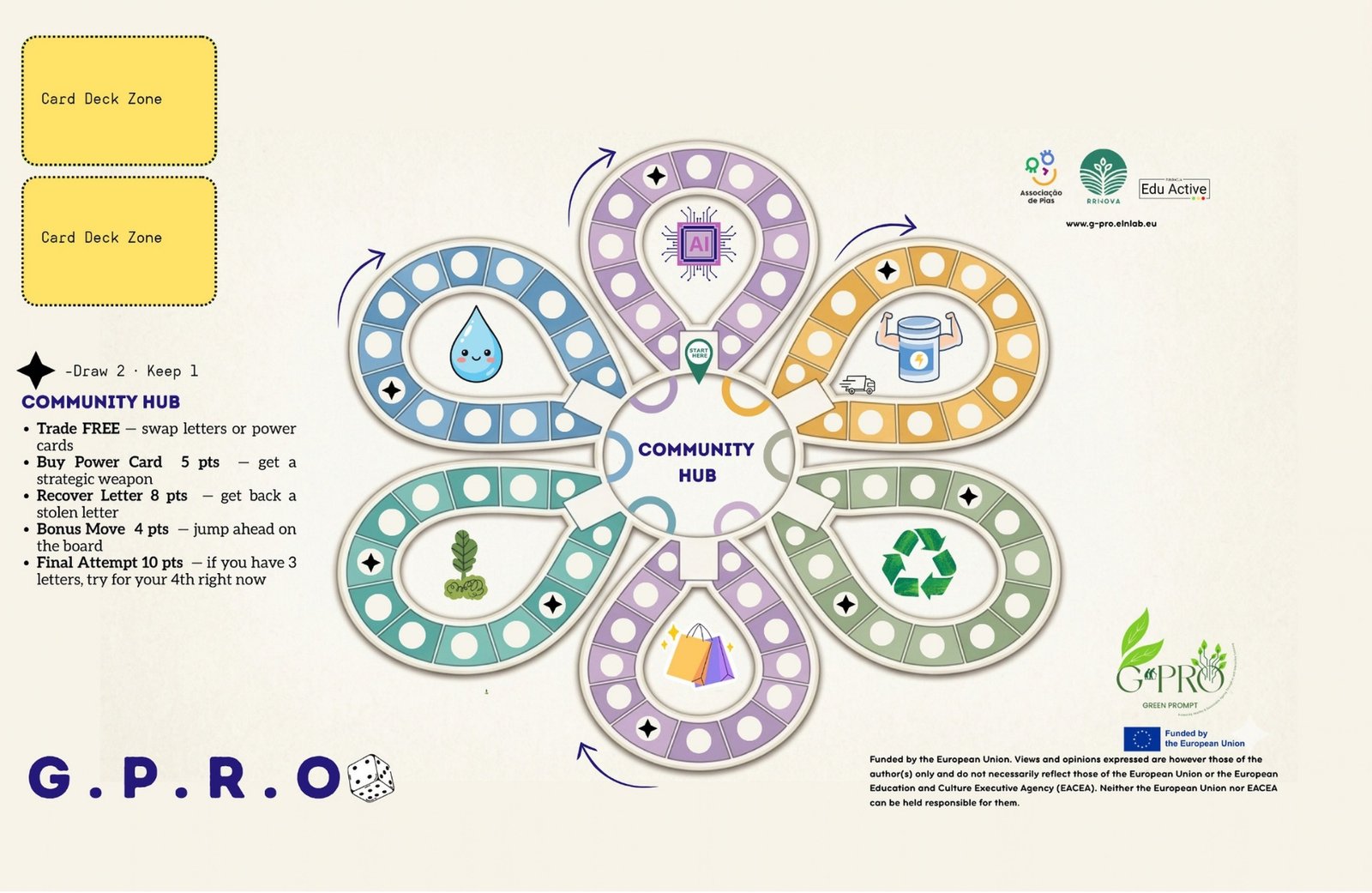
Six oval petals surround a central Community Hub. Players travel clockwise around a petal, from the hub to the tip and back.
| Petal colour | Theme | Letter it earns |
|---|---|---|
| Blue | Water | G |
| Gold | Energy | G |
| Teal | Nature | G |
| Grey-green | Recycling | G |
| Amber / Lavender | Shopping | R |
| Purple | AI Prompt | P |
Every card is drawn from the top of the one shuffled, combined deck, whichever petal you are on: the petal shows the theme, not which card you draw. (In G-PRO Online, an optional Theme mode draws cards that match the petal.)
White circle spaces: draw 1 Challenge Card. Black star (★) spaces: draw 2, choose 1 to play, return the other face-down to the bottom of the deck.
How to play a turn
- Roll and move. Move that many spaces clockwise along your petal. Each time you pass through the Community Hub you may choose which petal to enter.
- Draw a card. One card on a white circle; two (keep one) on a star.
- Read and answer. Read the card aloud. The question is for you, but everyone joins the discussion. Shopping cards (and a few others) have a situation printed in italic at the top: read the situation first, then the questions, and answer in the first person, as yourself. AI Prompt cards have three steps: ASK, EVALUATE and DECIDE.
- Receive a reward. The group decides: a full letter tile for a specific, personal answer with genuine reasoning; Community Points for a partial answer; a Power Card when the card shows ⚡. The O tile can be earned on any card for a specific named commitment.
- Pass the die clockwise.
The Community Hub
When you move into or through the hub you may take one action, or do nothing. The hub is never a penalty. You cannot use a paid action you cannot afford: with 0 points you do nothing and roll normally on your next turn. After a hub action, play your next turn normally: roll and move along any petal you choose.
| Action | Cost | What it does |
|---|---|---|
| Trade | Free | Swap one letter tile or Power Card with another player, if both agree. |
| Buy Power Card | 5 pts | Draw one Power Card and keep it hidden in your hand. |
| Recover Stolen Letter | 8 pts | Take back the letter tile most recently stolen from you, from the player who currently holds it. |
| Bonus Move | 4 pts | Move 2 extra spaces along your current petal. |
| Final Attempt | 10 pts | Only with exactly 3 tiles: draw a card now, without rolling or moving first, and try for your 4th letter. Once per visit to the hub. If the card’s letter is one you already hold, you earn Community Points instead; if a Wild Card comes up, draw again. |
Power Cards
32 cards, 8 types × 4. Keep them hidden in your hand; there is no hand limit. Get one when a card shows ⚡, or buy one in the hub for 5 points.
| Card | When | Effect |
|---|---|---|
| Shield | React instantly | Someone plays a Steal against you: put Shield down before they take a tile and the Steal is cancelled. |
| Block | React instantly | A player is about to receive a letter tile: they earn no letter tile this turn, but still earn any Community Points. |
| Steal | Start of your turn, before rolling | Take one random letter tile from a player who holds at least one. They mix their tiles face-down; you cannot choose. The target may play Shield to cancel it. |
| Swap | Start of your turn, before rolling | Name a letter you want and one you give. Both players must already hold those letters. The swap cannot be refused. |
| Peek | Start of your turn, before rolling | Look secretly at the top 3 Challenge Cards and put them back in any order. |
| Shortcut | Start of your turn, instead of rolling | Move clockwise straight to the next ★ ahead on your petal. Draw 2 Challenge Cards, keep 1 and return 1 face-down. |
| Community Boost | Start of your turn, before rolling | Your next Challenge Card drawn this turn earns its full reward without completing the challenge. |
| Redraw | After drawing: straight after drawing, before reading | Return the card you just drew face-down to the bottom of the deck, unread, and draw the next one. No penalty. |
Wild Cards
20 Wild Cards are shuffled into the Challenge Deck. When one is drawn the whole table takes part. Wild Cards are resolved by the text on the card.
| Wild Card | What happens |
|---|---|
| Memory Round | Everyone names a sustainable habit from an older generation. Each genuine memory earns 2 points. |
| Best Tip at the Table | Everyone shares their most useful habit. The group votes; the winner earns 4 points. |
| The Debate | Half argue FOR, half AGAINST for two minutes. Everyone votes; the winning side earns 3 points each. |
| Green Audit | Two good habits, one wasteful one and a specific change for this week: earn 3 points. |
| The Sustainability Promise | Each player who makes a believable, specific commitment earns 2 points. |
| Community Action | Agree a neighbourhood improvement; each player who commits to a specific step earns 3 points. |
| Ask the Eldest | The oldest player shares a habit they stopped and why. Discussion only. |
| Pass It On | Everyone shares something learned today. The group votes; the winner earns 3 points. |
| Heatwave | Three ways to help an elderly neighbour. A practical answer earns 5 points shared. |
| The Food Swap | Everyone names a food and a sustainable swap. The group votes; the winner earns 3 points. |
| The Last Wild Card | Everyone names a change they will make. The most ambitious earns 5 points. |
| Extra Turn | Take a complete extra turn now, before passing the die. |
| Community Boost | The card you draw on your next turn earns its full reward without completing the challenge. |
| Shortcut | Move clockwise to the next ★ ahead on your petal, draw 2 and keep 1. This is your complete turn. |
| Everybody Draws | Starting with you, every player draws and plays one Challenge Card before the die moves on. |
| Swap Positions | Swap pawns with any other player. No card is drawn. |
| Steal | Take one random letter tile from another player. They may cancel it with Shield. |
| Knowledge Check | Ask a player a question about one of their letters. Good answer: they keep it; no answer: it returns to the supply; no good question: you lose 3 points. |
| Double or Nothing | Before reading your next card choose DOUBLE (a letter earned this turn gives two copies, points only give zero) or NOTHING (play normally). |
| The Green Challenge | The player on your left sets you a specific action for this week. Report back next session: 5 points if done. |
Knowledge Check was labelled “Block Card” on some earlier printings. If your deck says “Block Card”, play it as Knowledge Check.
AI Prompt cards
These need a phone or tablet at the table. All three steps must be completed to earn the P tile.
- ASK — type a specific prompt into an AI tool such as ChatGPT, Microsoft Copilot or Google Gemini. Include who you are, where you live and what you want to know. A vague question gets a vague answer.
- EVALUATE — read the answer aloud. Is it specific to this person? Is it accurate? What did it miss? Does the group know better?
- DECIDE — the player decides what to do, change, or what the AI got wrong. The decision must come from the player, not simply from the AI.
Winning the game
The first player to hold G, P, R and O announces “G-PRO!” and wins immediately. If the deck runs out first, the round finishes and the player with the most letter tiles wins; a tie on letters goes to the most Community Points, and players still tied share the win.
Short session (about 45 to 60 minutes): agree in advance to play until the deck is half used, then finish the round. The player with the most letter tiles wins (ties: Community Points). A player who completes G-PRO before then still wins immediately.
Notes for the facilitator
The facilitator guides the session without playing competitively. The group — not the facilitator alone — decides whether an answer earns a letter. Useful questions:
- Was the answer personal and specific to this player's real life, or general?
- Did the player share a genuine thought, memory or commitment, or a polite one-line reply?
- For the O tile: is the commitment precise enough that everyone will know next session whether it was done? (e.g. “I will descale my kettle this Thursday.”)
A full session with 4–6 players takes 60–90 minutes. For a shorter session of about 45 to 60 minutes, play until half the deck is used, then finish the round. Across two sessions, players keep their tiles and points; anyone who completed a committed action earns 5 Community Points at the start of the next session.
Print & play downloads
Everything you need to print and play G-PRO at home or in a learning centre.
- Board: print on A2 or larger (or A3 for a small table), ideally on thick paper or mounted on card.
- Cards: print the card PDFs double-sided on A4 card stock (250–300 g/m², flip on the long edge) and cut along the crop marks. Each front sheet is followed by its back sheet. Card size 63.5 × 88.9 mm, the same as the original print.
- Tiles, tokens & pawns: print the components PDF (letter tiles double-sided), cut out, and add one six-sided die.
G-PRO Online: extra table rules
G-PRO Online follows these rules. To run a whole table on one screen, it also makes a few facilitation choices that the printed rules leave to the group:
- Three-way vote (instead of the printed game’s thumbs up or down). The other players vote Genuine, Partly or No. A majority for Genuine gives the card’s full printed reward (letter, points or ⚡). If Genuine and Partly together make at least half, the answer earns 1 Community Point. Otherwise it earns nothing.
- Letter already held. If the player already holds the card’s letter, they earn 2 Community Points instead.
- Own It. The printed rules allow a commitment at any time; the app asks for it once per card, after the vote, while the player does not yet hold O. The commitment is typed in and the other players vote thumbs up or down; a majority earns the O tile. Block can stop the O tile like any other letter.
- AI Prompt cards. The P tile needs all three steps ticked. Without a phone or tablet (a setup option, or chosen card by card), the Rules let the table skip the card or replace it with a discussion of what the AI would say and whether the group agrees. A skipped card goes to the bottom of the deck and the next card that is not an AI Prompt card is drawn. The Rules give no reward for the discussion, so it earns no P tile and no Power Card: only a card that prints Community Points pays them, on a Genuine majority. Own It can still be earned.
- Theme mode (optional, off by default): cards drawn match the petal you land on, plus Wild Cards. Peek is not available in Theme mode.
- Short session: the last round starts once half of the deck (75 cards) has been drawn.
- Moving through the hub: your move stops in the hub for one action, then the remaining steps continue into a petal of your choice (after a Bonus Move, along your current petal). Landing exactly in the hub ends the turn without a card. A Final Attempt uses up any remaining steps.
- Trades are always one item for one item.
- Power Cards stay hidden: the screen shows only how many each player holds, and a player opens their own hand with the others looking away. Only the player whose turn it is plays “start of your turn” cards. Redraw can be played by whoever has just drawn a card, including during Everybody Draws, before any AI step is ticked. The app asks about Shield and Block without showing who holds them, and a Power Card given in a trade is chosen privately by its owner. When the Power Deck runs out, the discards are reshuffled.
- Wild Cards: during Everybody Draws and Double or Nothing, any Wild Card drawn goes to the bottom of the deck and the next card is used (during Everybody Draws, Theme mode does not apply). The facilitator splits Heatwave’s 5 shared points.
- Commitments are saved on the device and matched by player name, so players can report back next session for 5 points.
- Facilitator tools: an optional 2-minute discussion timer and an Adjust mode to correct points, tiles and Power Cards.