
Keep your data yours: using AI without oversharing
Treat an AI chat like a public postcard, not a private diary. Here is what to keep out of your chats and how to take more control of your privacy.
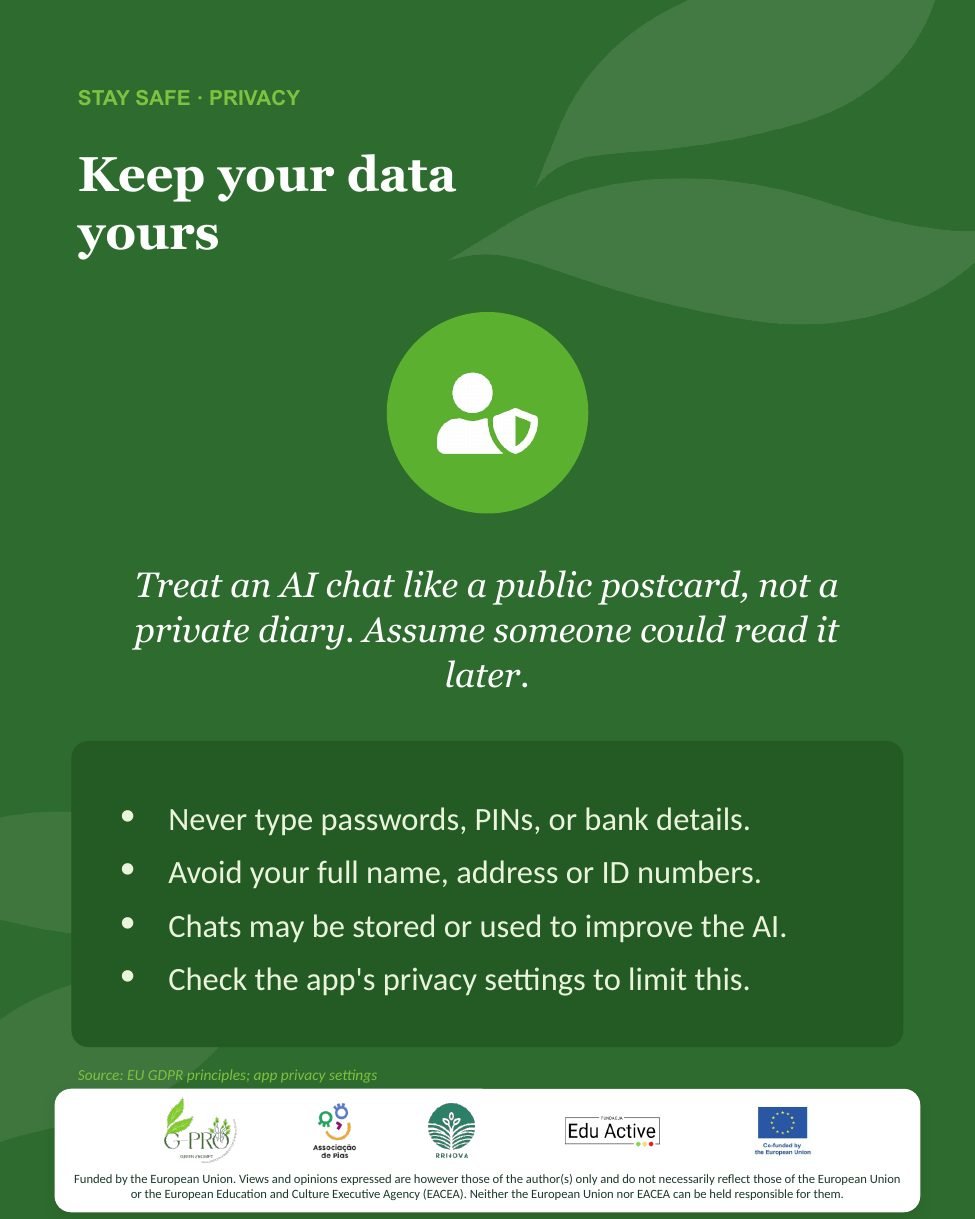
Chatting with an AI assistant can feel private. It is just you and the screen, and the replies are friendly and patient. But it helps to think of it differently. Treat an AI chat like a public postcard, not a private diary. Assume someone could read it later.
That simple picture makes it much easier to decide what to type and what to keep to yourself.
What never to type
Never type passwords, PINs or bank details into an AI chat. No genuine AI assistant needs them to help you, and if a chat or message ever asks for them, treat it as a warning sign.
It is also wise to avoid your full name, home address or ID numbers, such as a passport or national identity number. If you need help with a letter or form, you can use placeholders instead, for example "[my name]" or "[my address]", and fill in the real details yourself afterwards.
Your chats may be stored
Chats may be stored, or used to improve the AI. This varies between services, but the safe approach is to assume that what you type does not simply disappear. Before sharing something personal about your health, your finances or another person, ask yourself whether you would be comfortable writing it on a postcard.
You can still get excellent help without personal details. Instead of "My name is Maria Rossi and I live at…", try "I am a woman in my seventies living alone in a small town…". That gives the AI enough context to be useful without revealing who you are.
Check the privacy settings
Most AI apps include privacy settings that let you limit how your chats are stored or used. It is worth checking the app's privacy settings and choosing the options that suit you. If the menus feel confusing, ask a trusted family member, friend or local digital helper to go through them with you.
Learn more
The G-PRO Handbook chapter on staying safe and private online with AI explains how to protect your personal information in more detail. The G-PRO board game includes privacy questions that make a good starting point for group discussion.
Source: EU GDPR principles; app privacy settings
More from G-PRO

What AI actually is (and what it isn't)
AI can feel mysterious, but the basic idea is simple. Here is a plain-language look at how today's AI works, what it cannot do, and why you stay in charge.
Read more →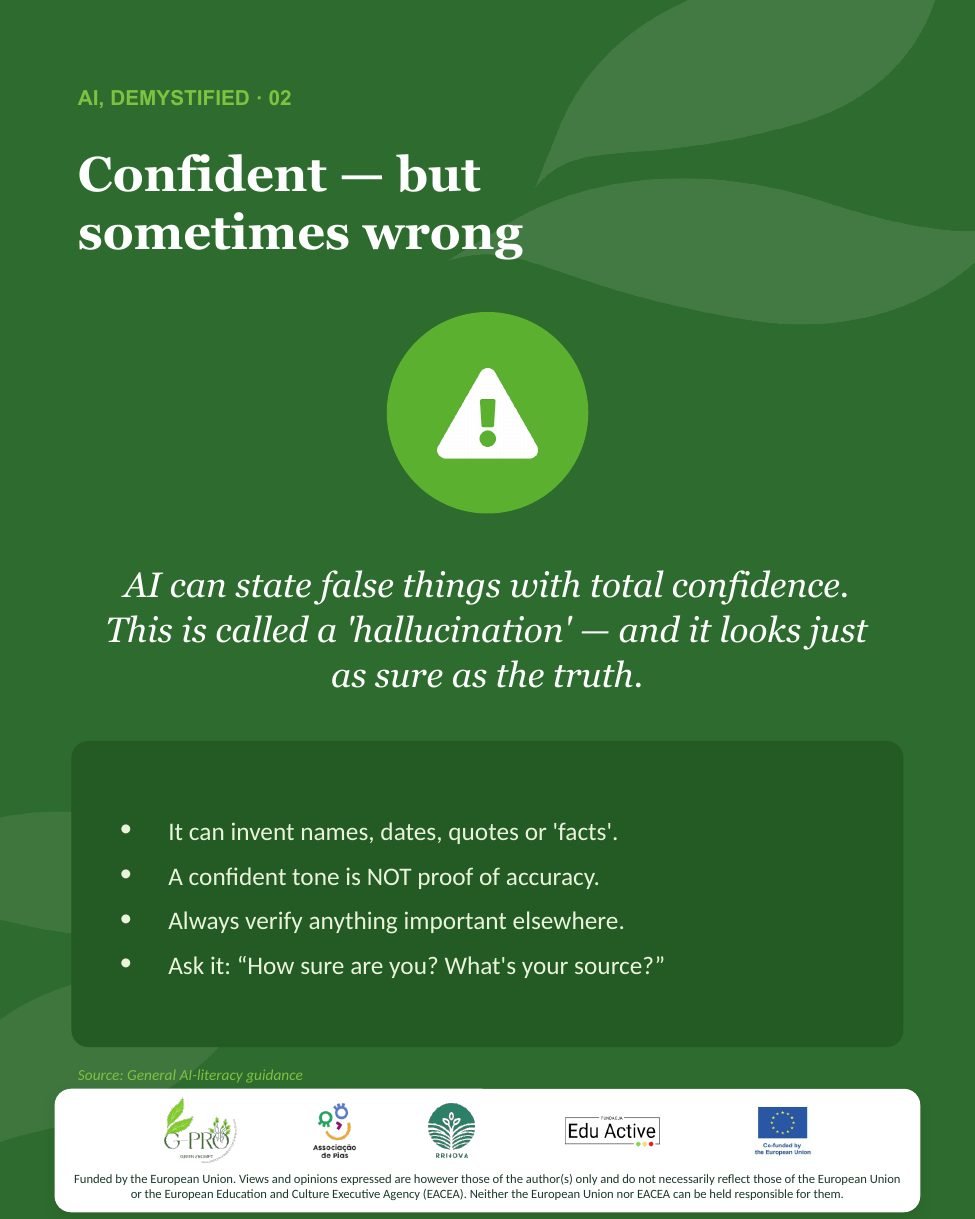
Confident, but sometimes wrong: understanding AI "hallucinations"
AI can state false things with total confidence. Learn what a hallucination is, why a sure tone is not proof, and simple ways to check what AI tells you.
Read more →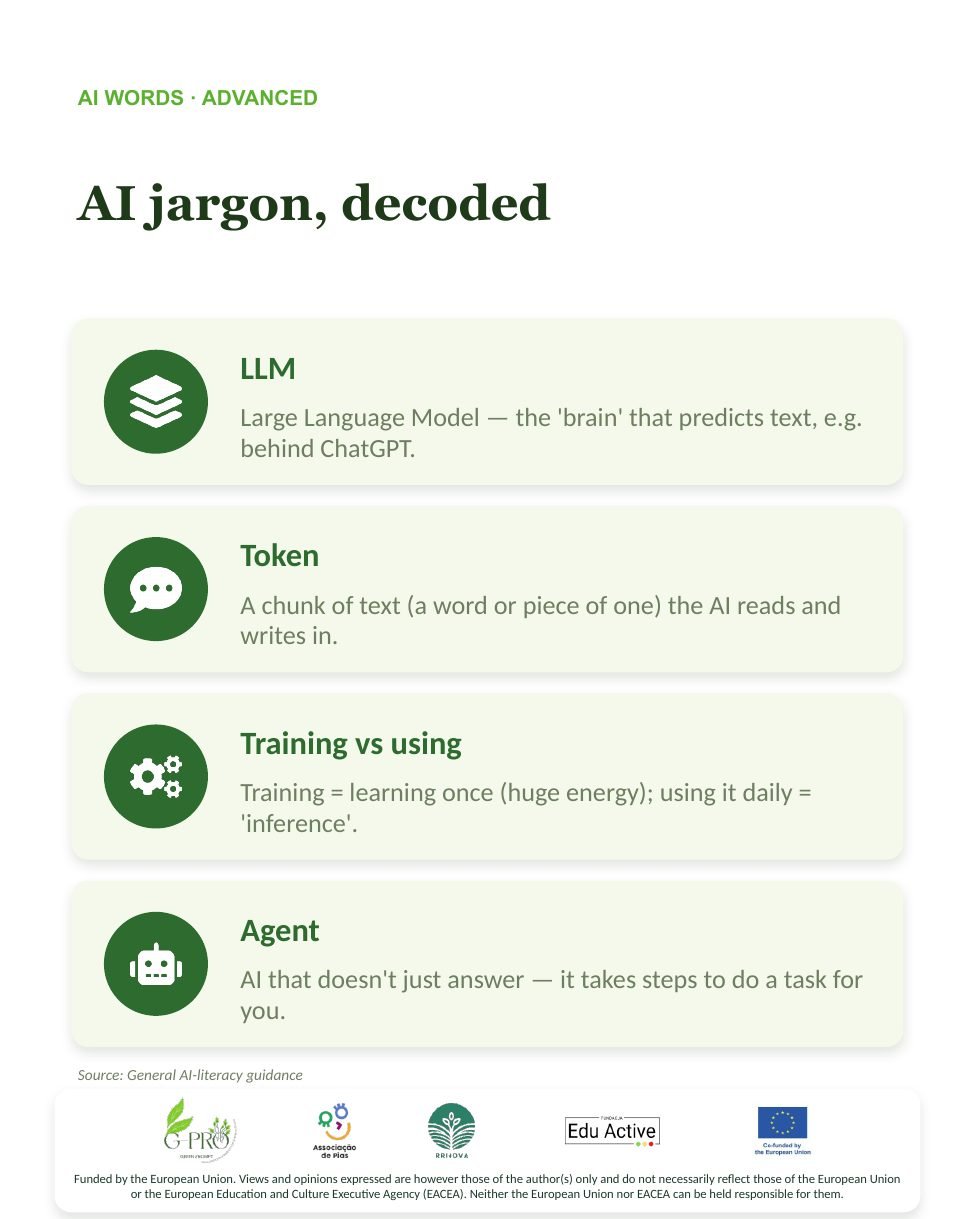
AI jargon, decoded: four words worth knowing
LLM, token, inference, agent: AI comes with a lot of new vocabulary. Here are four common terms explained in plain language.
Read more →